
Zrozumienie raportu genetycznego Twojego dziecka
Kiedy po raz pierwszy otrzymujesz raport genetyczny o swoim dziecku, może się wydawać, że jest on napisany w zupełnie innym języku.
Długie słowa. Ciągi liter i cyfr. Tabele pełne kodów, które wydają się niemożliwe do zrozumienia.
Wielu rodziców mówi nam to samo:
„Mamy raport… ale tak naprawdę nie rozumiemy, co on oznacza”
Jeśli brzmi to znajomo, nie jesteś sam.
Ten przewodnik pomoże Ci zrozumieć najważniejsze elementy raportu genetycznego, dzięki czemu będziesz mógł poczuć się pewniej czytając go — bez konieczności zostania naukowcem.
Celem nie jest rozszyfrowanie każdej liczby ani szczegółu technicznego. Zamiast tego chcemy pomóc Ci rozpoznać główne informacje i zrozumieć rodzaj zmiany genetycznej, jaką ma Twoje dziecko Gen NARS1i wiedz, gdzie znaleźć dalsze wsparcie.
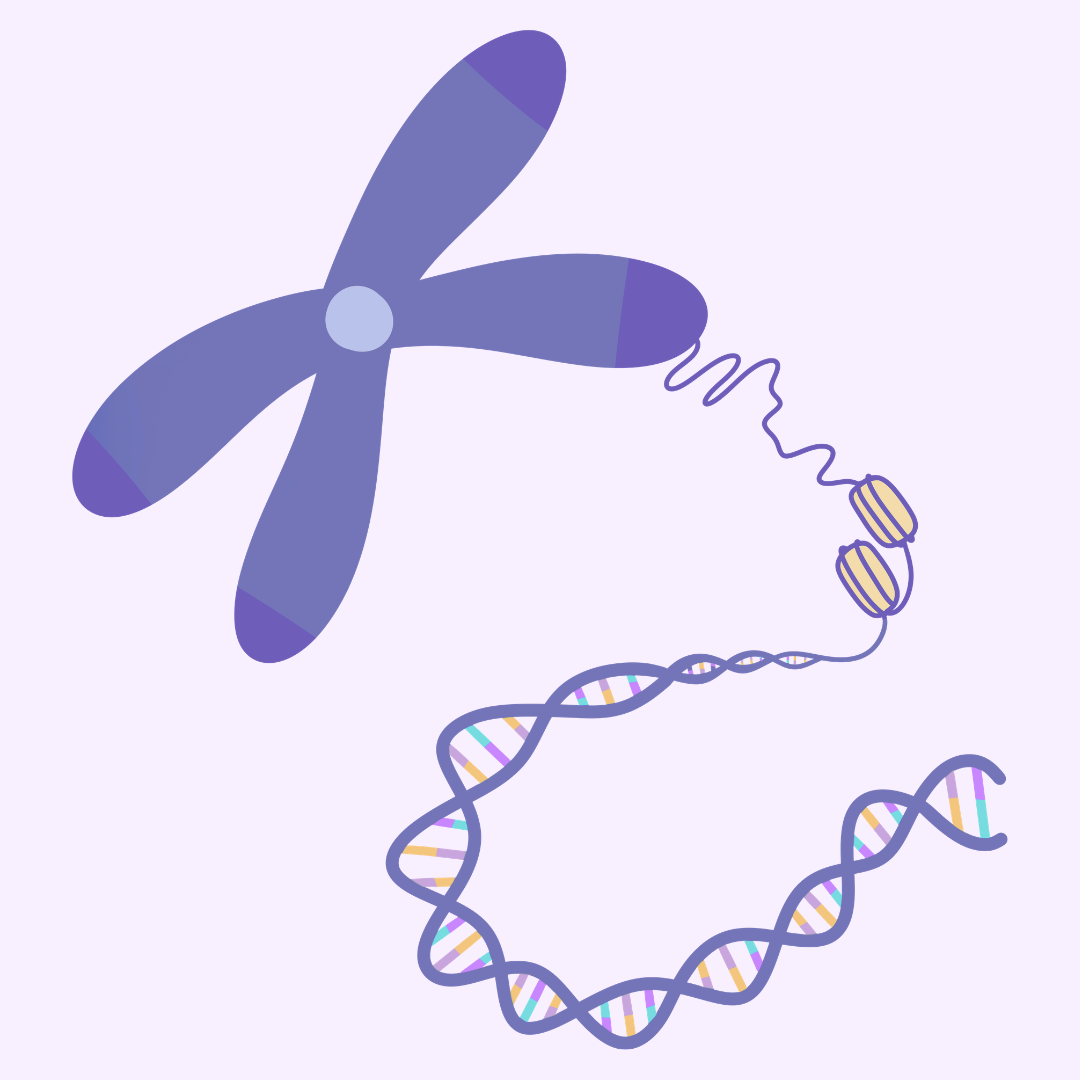
Krótkie podsumowanie: DNA, geny i chromosomy
DNA
DNA to długi kod chemiczny, który zawiera wszystkie instrukcje dotyczące wzrostu i działania organizmu. DNA to prosty alfabet składający się z zaledwie czterech liter: A, C, T i G.
Geny
DNA dzieli się na określone sekcje zwane genami. Są jak pojedyncze przepisy zapisane wzdłuż DNA. Każdy gen mówi organizmowi, jak wytworzyć określone białko, które wykonuje ważną pracę.
The Gen NARS1 zawiera instrukcje dotyczące wytwarzania białka NARS1, które pomaga komórkom budować inne białka potrzebne organizmowi.
Chromosomy
Chromosomy są jak książki zbudowane z DNA, które zawiera wiele genów. Ludzie zazwyczaj mają całe swoje DNA podzielone na 46 chromosomów, zaaranżowane w 23 pary. Każdy rodzic dodaje jeden zestaw chromosomów (23) do 46 chromosomów dziecka.
Większość genów wchodzi dwa egzemplarze — po jednym odziedziczonym po każdym rodzicu.
Jeżeli jedna lub obie kopie genu zawierają istotną zmianę (zwaną a wariant), może wpływać na działanie tego genu i czasami prowadzić do stanu zdrowia.
Co tak naprawdę mówi ci raport genetyczny
Chociaż raporty genetyczne mogą wyglądać skomplikowanie, zwykle odpowiadają na trzy główne pytania:
Który gen jest zaangażowany i gdzie
Jakiego rodzaju zmianę (wariant) znaleziono
Co naukowcy obecnie uważają, że oznacza zmiana
Twój raport będzie zwykle zawierał tabelę opisującą zidentyfikowany wariant lub warianty.
Dla wielu rodzin NARS1 istnieją dwa warianty, po jednym odziedziczonym po każdym rodzicu. W innych przypadkach może pojawić się wariant de novo, co oznacza, że nastąpiło to spontanicznie u dziecka/w pobliżu zapłodnienia jaja.
Dlaczego niektóre raporty pokazują jeden wariant, a inne dwa
Istnieją dwa główne sposoby pojawiania się wariantów NARS1 w raportach.
Warianty de novo
Czasami pojawia się wariant nowość w DNA dziecka, mimo że żadne z rodziców nie jest nosicielem tej substancji w komórkach somatycznych (niebiorących udziału w rozmnażaniu).
To się nazywa a wariant de novo.
W takich przypadkach raport może jedynie wykazać jeden wariant.
Warianty dziedziczne
Jeśli oboje rodzice są nosicielami zmienionej kopii genu, dziecko może odziedziczyć dwa warianty.
Czasami są to:
Ten sam wariant w obu kopiach genu (zwany autosomalny recesywny lub homozygotyczny)
Dwa różne warianty (zwany związek heterozygotyczny)
W takich przypadkach raport zazwyczaj będzie zawierał: dwa wiersze lub dwie tabele, po jednym dla każdego wariantu.
Sekcja wariantów może wyglądać inaczej w różnych raportach
Każde laboratorium formatuje raporty nieco inaczej.
Niektóre raporty przedstawiają informacje w tabelach. Inni opisują warianty w akapitach lub podpunktach.
Sekcja opisująca wariant może również pojawiać się pod różnymi nagłówkami w zależności od laboratorium lub kraju.
Większość raportów zawiera takie szczegóły jak:
the nazwa genu
the opis wariantu
the klasyfikacja
the zygotyczność
the dziedziczenie
czasami współrzędne genomiczne
Możesz zobaczyć tytuły takie jak:
Wariant
Szczegóły wariantu
Wariant sekwencji
Odkrycie molekularne
Odkrycia genetyczne
Interpretacja wariantowa
Wykryty wariant
Mimo że sformułowanie może się różnić, podawane informacje są zazwyczaj bardzo podobne.
Jeśli nie masz pewności, do czego odnosi się dana sekcja, poszukaj nazwa genu (na przykład NARS1) i opis wariantu jest często najłatwiejszym sposobem na orientację.
Przykładowy wariant z raportu
Raport może zawierać tabelę wyglądającą mniej więcej tak:
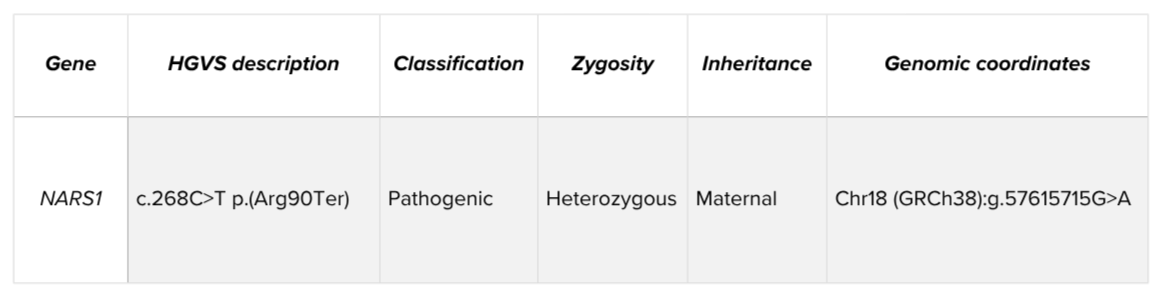
Na pierwszy rzut oka wydaje się to skomplikowane, ale każda część po prostu opisuje inny aspekt wariantu.
Rozłóżmy to.
Zrozumienie opisu wariantu HGVS
Opis wariantu jest zgodny z międzynarodowymi zasadami zwanymi Nomenklatura HGVS.
Choć wygląda technicznie, zazwyczaj składa się z dwóch kluczowych części:
a Zmiana na poziomie DNA
a zmiana poziomu białka
Przykład:
NARS1 c.268C>T p.(Arg90Ter)
Zmiana poziomu białka
Część zaczynająca się od p. opisuje, co dzieje się z białkiem, które gen normalnie produkuje.
Białka zbudowane są z elementów budulcowych zwanych aminokwasy, które są zapisywane przy użyciu kodów trzyliterowych.
Przykład:
p.(Arg90Ter)
Oznacza to:
Arg – arginina, aminokwas, który miał znajdować się w tej pozycji
90 – pozycja w białku
Ter – sygnał zatrzymania
To nam mówi:
„W pozycji 90 arginina została zmieniona na sygnał stopu”
Ten typ zmiany nazywa się a nonsens lub wariant stop-gain.
Ponieważ instrukcje kończą się wcześnie, białko może być niekompletne i niezdolne do prawidłowego funkcjonowania.
Czasami sygnał stopu jest zapisywany jako:
Ter
*
X
Wszystkie mają to samo znaczenie.
Zmiana poziomu DNA
Część zaczynająca się od c. opisuje zmianę sekwencji DNA genu.
Przykład:
c.268C>T
Można to podzielić na:
c. – to mówi nam, że patrzymy na kodującą sekwencję DNA
268 – pozycja w genie, w której następuje zmiana
C>T – litera DNA C została zastąpiona literą T
Oznacza to więc:
„Na pozycji 268 w genie NARS1 litera C została zastąpiona literą T”
Na poziomie DNA mogą również pojawić się inne zakończenia, takie jak:
del – usunięcie (litery usunięte)
ins – wstawianie (dodawane litery)
dup – duplikacja (skopiowane litery)
delins – litery usunięte i zastąpione innymi
Na przykład:
c.250_253del
Oznacza to, że litery na pozycjach 250–253 zostały usunięte.
Inne zmiany białkowe, które możesz zobaczyć
Wariant przesunięcia ramki
Przykład:
p.Lys84Serfs*12
Oznacza to:
lizyna w pozycji 84 staje się seryną
ramka odczytu przesunięć białka
sygnał stopu pojawia się 12 aminokwasów później
Przesunięcie ramki odczytu jest trochę jak usunięcie litery w środku zdania, wszystko po tym punkcie jest odczytywane nieprawidłowo.
W przypadku białek zwykle skutkuje to skróceniem i niefunkcjonalnością białka.
Wariant missense
Przykład:
p.Arg412Gly
Oznacza to, że arginina została zastąpiona glicyną w pozycji 412.
Usuwanie
Przykład:
p.Lys84del
Oznacza to, że aminokwas lizyna w pozycji 84 został usunięty.
Jak czytać swój wariant
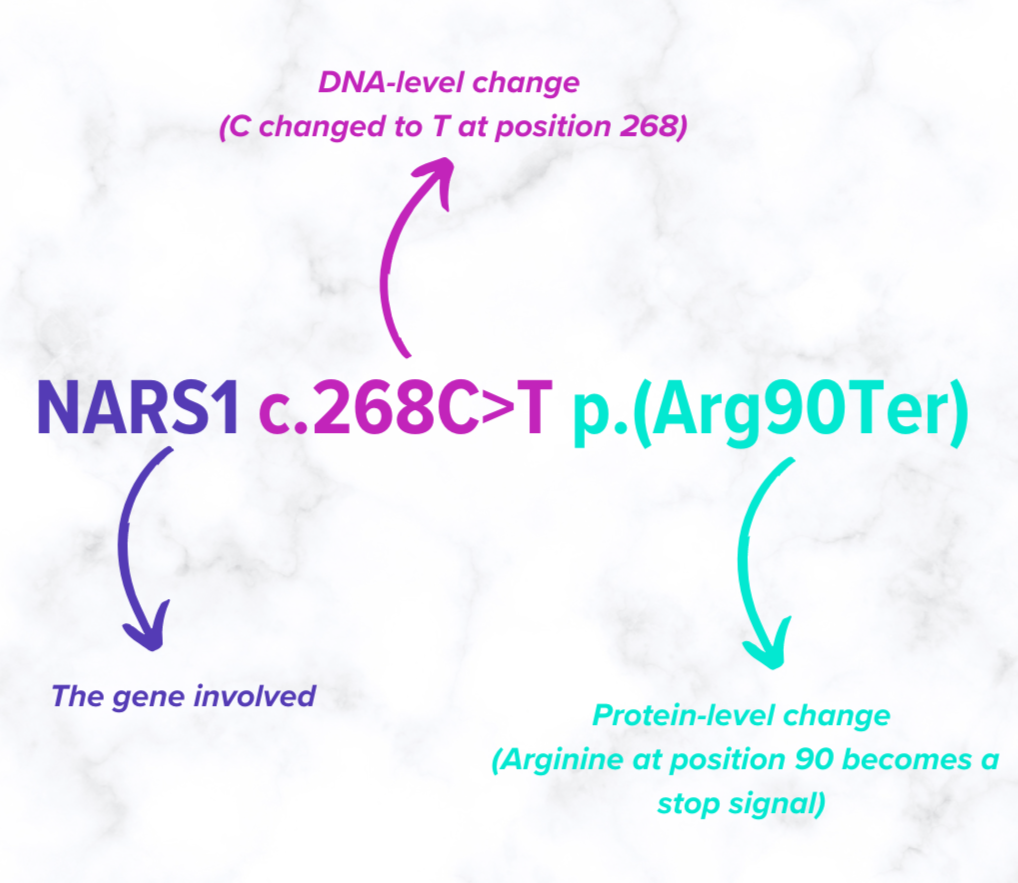
Skoro już masz wszystkie te informacje, jak je wykorzystać do odczytania i zrozumienia swojego wariantu?
Ten diagram przedstawia najważniejsze elementy opisu wariantu, dzięki czemu możesz szybko zobaczyć, co oznacza każda część.
Przykład:
NARS1 c.268C>T p.(Arg90Ter)
NARS1 – gen zaangażowany
c.268C>T – zmiana na poziomie DNA
p.(Arg90Ter) – zmiana poziomu białka
Zrozumienie pozostałych elementów raportu
Zygotyczność: ile kopii jest dotkniętych
W raporcie zostanie również opisana liczba kopii genu zawierających wariant.
Do powszechnie stosowanych terminów należą:
Heterozygotyczny
Jedna kopia genu ma wariant, a druga nie.
Homozygotyczny
Obie kopie genu zawierają ten sam wariant.
Związek heterozygotyczny
Każda kopia genu zawiera inny wariant.
Wiele dzieci z zaburzeniem NARS1 jest heterozygotami złożonymi: dwa warianty heterozygotyczne — po jednym w każdej kopii genu.
Dziedziczenie: skąd pochodzą warianty
Raport może również wskazywać, skąd pochodzą warianty. Wymaga to sekwencjonowania DNA rodziców razem z DNA dziecka.
Na przykład:
Matka – odziedziczone po matce
Ojcowski – odziedziczone po ojcu
De novo – nowy u dziecka i nieobecny u żadnego z rodziców w komórkach somatycznych
W rodzinach NARS1 obserwuje się zarówno warianty dziedziczne, jak i de novo.
Klasyfikacja: co według naukowców oznacza wariant
Laboratoria genetyczne również przypisują klasyfikacja, co odzwierciedla ich obecną wiedzę na temat wariantu.
Do typowych kategorii należą:
Patogenny - Chorobliwe.
Prawdopodobnie patogenny - Bardzo prawdopodobne, że powoduje chorobę.
Wariant o niepewnym znaczeniu (VUS) - Naukowcy nie wiedzą jeszcze, czy wariant ten powoduje chorobę.
Prawdopodobnie łagodny / łagodny - Mało prawdopodobne, aby powodował chorobę.
Ponieważ Zaburzenie NARS1 jest niezwykle rzadkie i wciąż jest przedmiotem badań, niepewne klasyfikacje są dość powszechne.
Może to wydawać się niepokojące, ale po prostu odzwierciedla fakt, że nauka wciąż się uczy.
W miarę identyfikowania większej liczby rodzin i przeprowadzania dalszych badań mogą pojawić się pewne warianty przeklasyfikowane w czasie.
Jest to jeden z powodów, dla których Fundacja Rory Belle ściśle współpracuje z rodzinami i badaczami na całym świecie — dzielenie się informacjami pomaga poprawić zrozumienie NARS1.
Współrzędne genomowe: lokalizacja GPS genomu
Niektóre raporty zawierają również coś, co nazywa się współrzędne genomiczne, co może wyglądać tak:
Chr18 (GRCh38):g.57615715G>A
Opisuje to dokładnie tę samą zmianę genetyczną, ale przy użyciu pełnej mapy ludzkiego genomu.
Rozbicie na części:
Chr18 – wariant zlokalizowany jest na chromosomie 18
GRCh38 – wersja ludzkiego genomu referencyjnego wykorzystywana przez laboratorium.
g.57615715G>A – w pozycji 57 615 715 na tym chromosomie litera DNA G zmieniło się na A
Można to sobie wyobrazić jako Współrzędne GPS wariantu w genomie ludzkim.
Naukowcy i laboratoria wykorzystują te informacje, aby mieć pewność, że omawiają dokładnie ta sama zmiana genetyczna podczas udostępniania danych i badań.
Rodzice na ogół nie muszą używać tej linii w życiu codziennym, ale może ona pojawić się w raportach, więc pomocne jest jej rozpoznanie.
Nie musisz wszystkiego rozumieć
Raporty genetyczne są skomplikowane, nawet dla profesjonalistów.
Zupełnie normalne jest, że rodzice czują się przytłoczeni, gdy czytają je po raz pierwszy.
Zrozumienie tylko kilku kluczowych informacji, takich jak nazwa genu, opis wariantui klasyfikacja, może już sprawić, że raport będzie wydawał się znacznie łatwiejszy w zarządzaniu.
Jeśli chcesz dowiedzieć się więcej o samym zaburzeniu NARS1, możesz przeczytać nasz przewodnik:
Jesteśmy tutaj, aby pomóc
Jeśli nie masz pewności, co oznacza raport Twojego dziecka, pamiętaj, że nie jesteś sam.
Fundacja Rory Belle jest tutaj, aby wspierać rodziny na każdym etapie — od diagnozy po zrozumienie nauki stojącej za NARS1.
Czasami pierwszym krokiem jest po prostu poproszenie kogoś o pomoc w wyjaśnieniu raportu prostym językiem.
Proszę skontaktuj się z nami jeśli potrzebujesz wsparcia
Ostatnie słowo - Jak raport genetyczny Twojego dziecka może wesprzeć badania
Gdy zaczniesz rozumieć raport genetyczny swojego dziecka, możesz również usłyszeć o jego roli w badaniach.
Udział w badaniach jest zawsze osobistym wyborem, ale dla rodzin, które chcą się zaangażować, raport genetyczny może odegrać ważną rolę.
Raport Twojego dziecka pomaga badaczom:
Dowiedz się dokładnie, jaki wariant ma Twoje dziecko
Dzięki temu zespoły badawcze mogą projektować badania, testy i potencjalne terapie dostosowane do konkretnych zmian genetycznych, bez konieczności zapamiętywania przez rodziny skomplikowanych szczegółów wariantów.Włącz swoje dziecko do platform badawczych i studiów historii naturalnej
Badania te pomagają uzyskać jaśniejszy obraz wpływu NARS1 na dzieci na przestrzeni czasu, co jest niezbędne do opracowania przyszłych metod leczenia.Lepiej zrozumieć wzorce dziedziczenia
W przypadku dziedziczenia wariantów informacje te mogą pomóc badaczom wykorzystać próbki macierzyste do porównań w laboratorium, co podniesie jakość badań.
Z biegiem czasu ta wspólna wiedza pomaga posunąć badania do przodu, przybliżając nas do lepszego zrozumienia NARS1 i opracowania przyszłych metod leczenia.
Jeśli chcesz dowiedzieć się więcej o tym, jak się zaangażować, możesz odwiedzić naszą stronę - Strona poświęcona studiom nad historią naturalną
Nigdy nie ma presji, aby wziąć udział, ale jeśli jesteś zainteresowany, Fundacja Rory Belle może poprowadzić Cię przez opcje.